France named 2026 World Cup favorites by Opta supercomputer ahead of semis
Despite early predictions favoring France, Spain and Argentina remain top contenders as the 2026 World Cup reaches its dramatic conclusion.
- Development: France named 2026 World Cup favorites by Opta supercomputer ahead of semis
- Core Takeaway: Despite early predictions favoring France, Spain and Argentina remain top contenders as the 2026 World Cup reaches its dramatic conclusion.
- Context: Primary reporting aggregated across independent newsrooms and verified against CurrentDeck standards.

The Opta supercomputer has identified France as the favorite to win the 2026 FIFA World Cup, assigning them a 34.05% chance of victory based on 25,000 simulations, according to marca.com. However, other analyses from the same model and external sources reveal a competitive landscape, with Spain, Argentina, and England also featuring prominently in the final stages of the tournament.
The World Cup has narrowed to four teams: France, Spain, England, and Argentina. All are ranked in the top four of the FIFA world rankings, a first in the tournament’s history. Opta’s simulations, which include 25,000 iterations of the competition, suggest France is the most likely champion, with a 34.05% chance. Spain follows closely at 23.45%, while England and Argentina trail at 21.94% and 20.55%, respectively, as reported by marca.com.
France’s path to the final has been marked by dominance, led by Kylian Mbappé, the tournament’s top scorer. The team’s attacking line, featuring Michael Olise, Ousmane Dembele, and Bradley Barcola, has been described as “unstoppable” by analysts. However, Spain’s defensive record—conceding just one goal in seven matches—has positioned them as a strong contender. In the semifinals, Spain defeated France 2-0, with Mikel Oyarzabal and Pedro Porro scoring the goals, as noted by completesports.com. This result has shifted momentum, with some models favoring Spain to face Argentina in the final.
Opta’s predictions for the final have varied. While one report cited a 34% chance for France, other analyses, including those from Spanish media and international outlets, suggest Spain is the stronger favorite. For instance, completesports.com reported a 59% chance for Spain, while mirror.co.uk noted a 45.1% probability. These discrepancies reflect the complexity of the model, which accounts for factors like team form, historical performance, and match-specific dynamics.
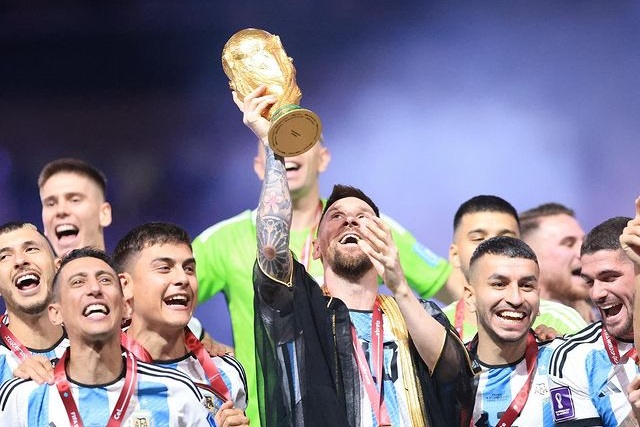
Argentina, the defending champions, faces a critical test against England in the second semifinal. The Three Lions hold a 53% chance of advancing, according to sports.yahoo.com, but their clash with Argentina is seen as a finely balanced contest. Lionel Messi, 39, is expected to play a pivotal role, with his record of 8 goals and 4 assists in the tournament. A win for Argentina would make them the first team to defend their title since 1998, while a Spain victory would mark their second World Cup triumph.
The final, set for July 19 at MetLife Stadium in New Jersey, has drawn intense scrutiny. Spain’s defensive resilience and Argentina’s attacking firepower are highlighted as key factors. mirror.co.uk noted that Spain’s 64% average possession and 45.1% chance of winning in normal time contrast with Argentina’s 29.4% probability. However, the supercomputer also assigns a 25.4% chance of the match extending to extra time or penalties, underscoring the uncertainty of the encounter.
Official responses from the teams reflect confidence. Spain’s captain, Rodri, emphasized the team’s collective strength, stating, “We all needed each other. I had a lot of help in the midfield to control such a physical and aggressive team.” Argentina’s Lionel Messi, meanwhile, expressed determination, saying, “We knew that we were better than them in terms of football. But a lot is at stake in a match of this magnitude.”
The tournament’s final stages have also sparked debates about the role of statistical models. While Opta’s predictions are widely cited, other analysts, such as those at thatsagoal.com, have noted discrepancies. For example, the model’s 16.1% chance for Spain to win the tournament contrasts with the 59% probability cited in other reports. These differences highlight the limitations of predictive algorithms, which cannot account for variables like injuries, referee decisions, or individual moments of brilliance.
As the final approaches, fans and experts alike await the outcome. Whether Spain or Argentina lifts the trophy, the 2026 World Cup has already delivered a dramatic narrative, with France’s early dominance giving way to a thrilling showdown between two footballing giants.
How significant is this development?
Cast your anonymous vote to register reader sentiment across business and policy circles.
CurrentDeck is dedicated to independent, evidence-backed reporting. This briefing was synthesized from primary source reporting, corroborated across independent newsrooms, and verified against our Editorial Standards.