Abnormal Las Vegas GP practice leaves F1 teams heading into the unknown
A washed-out opening practice session and limited running in FP2 have left Formula 1 teams heading into the unknown for the Las Vegas Grand Prix weekend.
Washed-out opening session
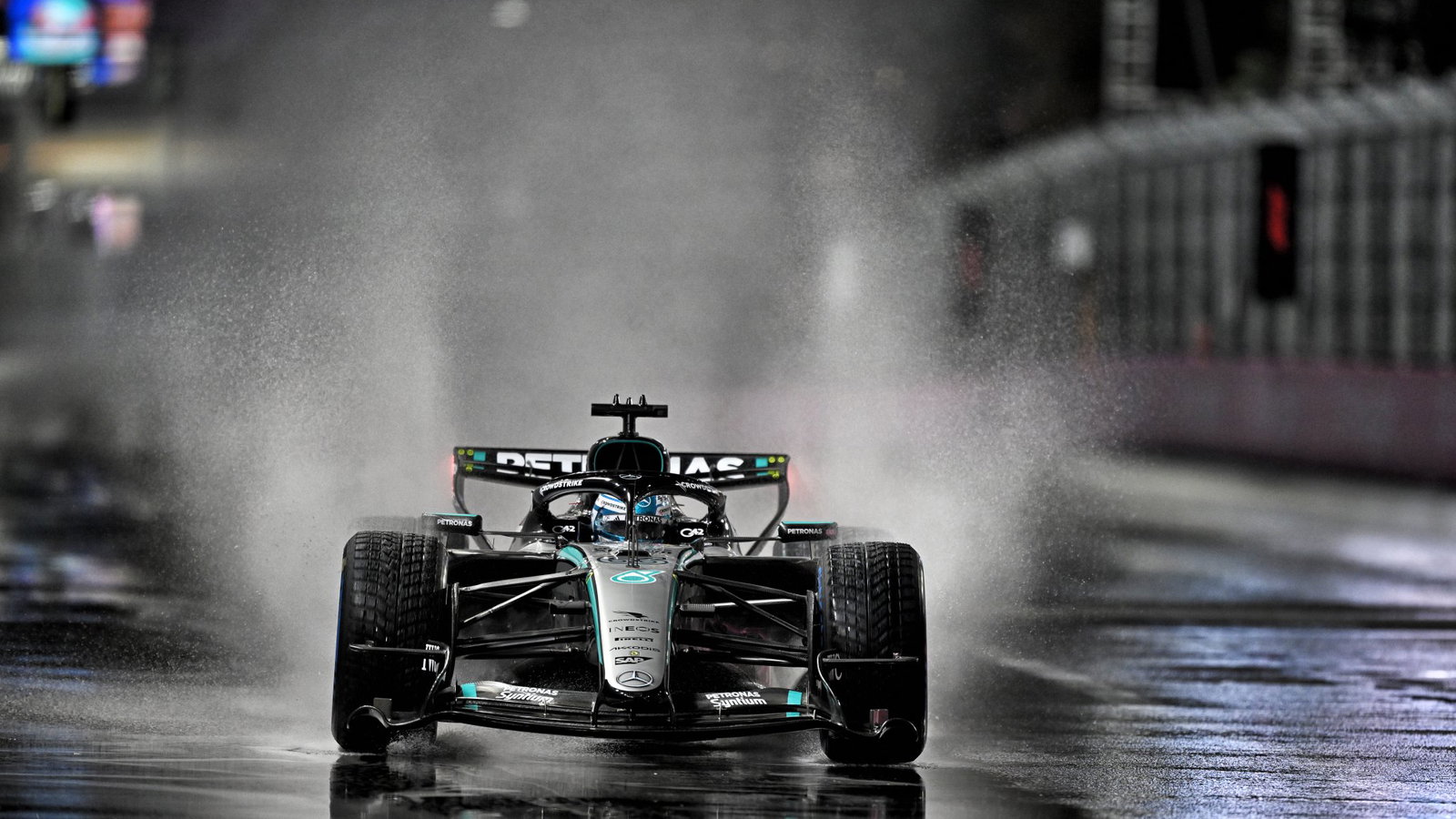
First practice was abandoned entirely. No driver completed a timed lap because the track was extremely wet, and teams chose to save their limited allocation of wet-weather tyres rather than risk damage. The session passed with cars largely confined to garages or completing only installation laps.
FP2 offers limited insight
Second practice provided the only running of the day, but on a wet track that slowly dried without further rain. Mercedes driver George Russell set the fastest time right at the end of the session, 0.071 seconds ahead of Alpine's Pierre Gasly. Ferrari's Charles Leclerc was third, ahead of Red Bull's Isack Hadjar, McLaren's Oscar Piastri, Lewis Hamilton, and Lando Norris. Kimi Antonelli, Franco Colapinto, and Fernando Alonso rounded out the top ten.
| Detail | Information |
|---|---|
| FP1 timed laps | None completed |
| FP2 fastest | George Russell (Mercedes) |
| FP2 second | Pierre Gasly (Alpine), +0.071s |
| FP2 third | Charles Leclerc (Ferrari) |
| Forecast for rest of weekend | Dry |
Drivers dismiss wet pace
Russell was taking very little away from the results. "We know in the wet it is different every lap, every session, realistically we were not the fastest today," he said. "McLaren looked exceptionally fast. Charles looked very fast at points, we just got the lap in when the track was at its driest and Norris didn't run. We have some things to understand because Kimi and I were very competitive in the wet last week and both of us were off the pace."
Hadjar added: "It was good fun but I don't think it's very useful for tomorrow. Just shaking down the car." Hamilton was equally blunt: "It wasn't a great day just sitting around waiting. You can't really test much in those conditions. And everything you learn from today you have to forget because tomorrow is supposed to be dry, so we kind of start from tomorrow. Everyone is [going in blind]. No-one has put the slicks on, so we will have to react quickly. Hopefully, it's not bad and we are there or thereabouts."
Track characteristics compound problems
Oliver Bearman, who missed FP1 as Haas test driver Ryo Hirakawa took over his car, explained why the Las Vegas circuit is uniquely unsuited to wet running. "This track is not made for these conditions," Bearman said. "It's incredibly cold this time of year. The track is also very, very smooth, so the smallest amount of water is enough to cause a lot of aquaplaning, because the water really sits on top. We have a lot of other tracks where, when it rains, the grip is actually still there. At turn 12 there's huge puddles and even in the straights as well the water takes a long time to go away. So if that was Brazil last week that amount of rain we would be running in FP1 but in this track it's impossible especially with those low temps with the tyres we have this year. So it's a real recipe for disaster."
Hirakawa confirmed the grip was even lower than expected: "It was quite tricky. I knew that the track was going to be very slippery, but it was even worse than I thought. There was no grip and I just wanted to complete all the check-ups [to see] that the car was working. I took margin, but there was no grip out there."
Upgrades held back
The conditions forced teams to abandon planned development work. McLaren elected not to run a new floor on Lando Norris's car. "The conditions made it difficult to evaluate the car properly," said McLaren's senior director Randy Singh. "In the wet, we had to tape up some of the sensors, which meant we could not always get the evidence we wanted, so we decided not to fit the new floor because of the risk and because we did not think we would learn much from it in these conditions. We hope to run it tomorrow and assess it more effectively." Red Bull similarly abandoned plans to trial a front wing upgrade.
Final practice becomes critical
Ferrari deputy team principal Jerome d'Ambrosio described the situation: "I think tomorrow will be a reset for everyone, and that's when the weekend will really start. I think we're going to have to condense the long runs and the short runs for Qualifying. We'll try to squeeze everything into one hour. But we have no choice. It's like this for everyone, and we'll have to make the most out of it."
Teams must now compress both race and qualifying simulation runs into the single remaining hour of practice. The challenge is compounded by tyre warm-up difficulties in cold conditions with low vertical loads, exacerbated this year by the new 'straight-line mode' in which wings open to reduce drag on straights. "It's always a challenge here in Vegas but the added challenge this year with the nature of the cars, the SM zones everywhere, you're not putting any vertical load in the tyres so they are getting substantially cooler in the straight than in the previous years and they were already pretty cool," Russell said.
Grid penalties add further complexity
Several drivers face grid penalties that will shape the weekend. Oscar Piastri will take a 10-place penalty for exceeding his engine-part allowance, requiring a fifth internal combustion engine after a failure in Mexico City. Carlos Sainz also incurs a 10-place penalty for a fifth turbocharger, while teammate Alex Albon avoids penalty despite fitting the same upgrade. At Mercedes, only Antonelli will use the new turbo; Russell would have faced a 15-place penalty. Bearman is also set to start from the back of the grid due to engine changes.
Tyre unknowns remain
Russell highlighted the key unanswered question: "I think nobody knows how the graining is going to be for Sunday. Last year was an easy one-stop but the year before there was lots of graining and it was a two-stop. So they're questions that we want answered but we probably won't get an answer until race day." The unknowns from practice will make setting the cars up for qualifying and the race very difficult, throwing additional jeopardy into the mix and increasing the chance of a surprise result.
Final practice now represents the only opportunity for teams to gather dry-running data before qualifying, with every team facing the same compressed programme and the same blank slate.
CurrentDeck is dedicated to independent, evidence-backed reporting. This briefing was synthesized from primary source reporting, corroborated across independent newsrooms, and verified against our Editorial Standards.