NASA Invites Public to Shine Lights for Voyager 1 Light-Day Milestone
NASA is asking people worldwide to shine lights into the night sky as Voyager 1 approaches a distance of one light-day from Earth, the farthest any human-made object has ever traveled.
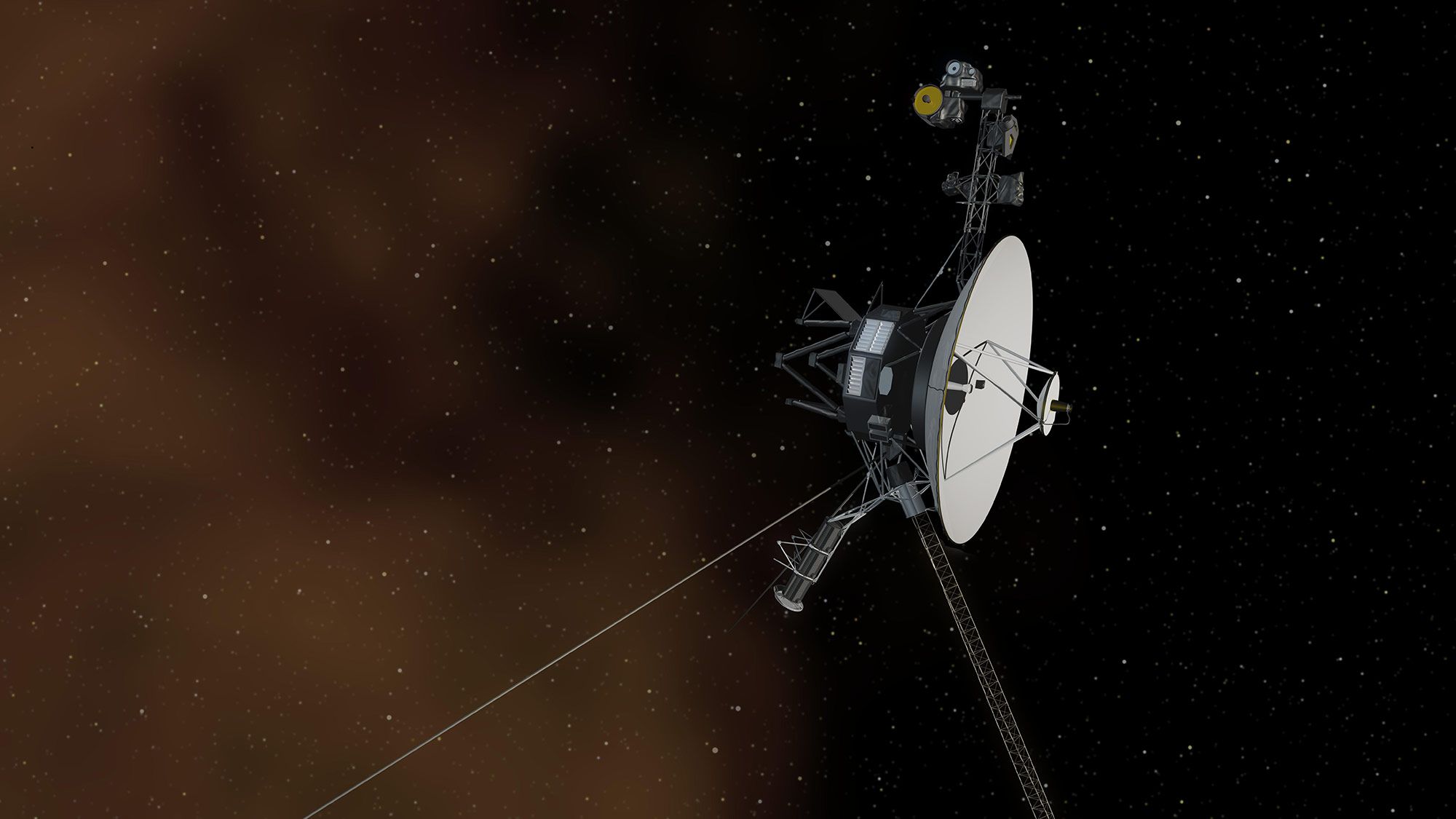
NASA Invites Public to Shine Lights for Voyager 1 Light-Day Milestone
NASA is inviting people around the world to flash lights into the night sky on Tuesday, Nov. 17, as Voyager 1 approaches a distance of one light-day from Earth — the farthest any human-made object has ever traveled.
The event, called "Shine Bright for Voyager's Light-Day," takes place after sunset on Nov. 17, the day before Voyager 1 reaches the milestone on Wednesday, Nov. 18. At that distance, light itself takes 24 hours to travel from Earth to the spacecraft.
| Detail | Information |
|---|---|
| Milestone date | Wednesday, Nov. 18, 2026 |
| Milestone time (EST) | 5:16:07 a.m. |
| Milestone time (GMT) | 10:16 GMT |
| Distance at milestone | About 16 billion miles (26 billion kilometers) |
| Distance in astronomical units | About 173 AU |
| Voyager 1 launch date | Sept. 5, 1977 |
| Voyager 2 launch date | Aug. 20, 1977 |
| Voyager 2 expected light-day milestone | November 2035 |
| Operational instruments | Two |
| One-way signal travel time | Approximately 24 hours |
| Round-trip command time | About 48 hours |
| Public celebration | After sunset Tuesday, Nov. 17 |
| Signal to flash | VGR in Morse code |
| Social media tag | @NASA |
| NASA discussion event | Thursday, Nov. 19, 12 p.m. EST (1700 GMT) |
Participants are encouraged to use a flashlight, phone light, bike light, or other portable light source to flash Voyager 1's three-letter call sign, VGR, in Morse code: three quick flashes followed by one long flash for V, two long flashes and one quick flash for G, and one quick flash, one long flash, and another quick flash for R. NASA has created an automated flasher that runs in a smartphone or tablet browser to display the sequence. The agency asks participants to repeat the sequence for about a minute and to photograph or record their signals for social media, tagging @NASA.
NASA stresses that the light display is symbolic only. A flashlight beam cannot reach Voyager 1; the agency communicates with the probe through its Deep Space Network of radio dishes. At one light-day away, a radio signal takes roughly 24 hours to reach the spacecraft, and another 24 hours for a reply to return — meaning a command and response cycle takes about 48 hours.
Voyager 1 launched on Sept. 5, 1977, and has spent nearly 50 years traveling through space. It crossed into interstellar space in August 2012 after passing the heliopause, and it remains the most distant human-made object from Earth. Its twin, Voyager 2, launched two weeks earlier on Aug. 20, 1977, but took a different trajectory past Uranus and Neptune and is expected to reach the one-light-day mark in November 2035.
The milestone comes as Voyager 1's power supply continues to decline. NASA has gradually shut down scientific instruments to conserve energy, leaving only two operational: the magnetometer and the plasma wave subsystem.
The University of Iowa has been involved with the mission since launch. Research scientist William Kurth witnessed the liftoff at Cape Canaveral and has worked on the mission ever since. He is principal investigator on the plasma waves instrument, designed and built at Iowa under the late physicist Donald Gurnett. That instrument helped detect lightning on Jupiter, revealed that Saturn's rings contain dust, and confirmed in 2012 that Voyager 1 had entered interstellar space. Kurth succeeded Gurnett as principal investigator in 2022. Allison Jaynes, associate professor and director of graduate studies in Iowa's Department of Physics and Astronomy and a Voyager co-investigator, called the light-day milestone "our first step toward visiting distant stars." Other Iowa contributors include Larry Granroth, scientific programmers Chris Piker and Jeremy Faden, and graduate student Brendan Powers.
Susie Dodd, project manager for the Voyager mission at JPL, illustrated the communication delay by noting that a "good morning" sent Monday morning would not receive a reply until around Wednesday morning.
The public celebration will be followed by a moderated discussion on Thursday, Nov. 19, at 12 p.m. EST (1700 GMT), hosted by NASA's Jet Propulsion Laboratory in Southern California. Voyager mission team members and NASA leadership will cover the current status of both spacecraft, their continuing scientific observations in interstellar space, and the engineering challenges of keeping the nearly 50-year-old probes operational. NASA will also preview an upcoming Voyager documentary planned for release in 2027, coinciding with the mission's 50th anniversary.
Voyager 1 will reach one light-day from Earth on Wednesday, Nov. 18, at 5:16:07 a.m. EST, becoming the first human-made object to travel a distance that light itself takes a full day to cross.
CurrentDeck is dedicated to independent, evidence-backed reporting. This briefing was synthesized from primary source reporting, corroborated across independent newsrooms, and verified against our Editorial Standards.