Nobel medicine prize goes to 3 scientists for research into brain activity
Three scientists have been awarded the Nobel Prize in medicine for their groundbreaking research into optogenetics and light-controlled brain circuits.
- Development: Nobel medicine prize goes to 3 scientists for research into brain activity
- Core Takeaway: Three scientists have been awarded the Nobel Prize in medicine for their groundbreaking research into optogenetics and light-controlled brain circuits.
- Context: Primary reporting aggregated across independent newsrooms and verified against CurrentDeck standards.
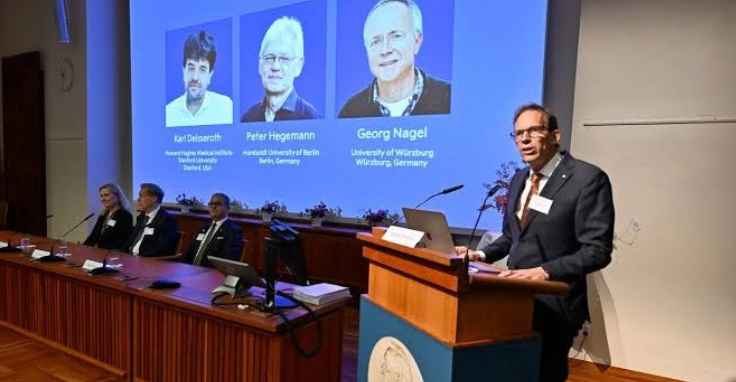
Karl Deisseroth, Peter Hegemann, and Georg Nagel: Pioneers in Optogenetics
The Nobel Prize in medicine was awarded to Karl Deisseroth, Peter Hegemann, and Georg Nagel for their novel research into light-gated ion channels and optogenetics. According to the Nobel Assembly, their method "is now being used in laboratories around the world to reveal the brain's mysteries." The assembly stated that Deisseroth is based at Stanford University in California, while Hegemann is at Humboldt University in Berlin and Nagel at the University of Wurzburg, also in Germany.Optogenetics: A New Era in Neuroscience
Optogenetics is a technique that uses light to control the activity of individual nerve cells in the brain. It started when Hegemann explored how a single-celled type of green algae can swim toward light. He and Nagel discovered a particular protein that, when illuminated by blue light, opens a channel to create an electrical impulse. Putting that protein into other cells makes them light-sensitive. Deisseroth then worked with the gene that controls that protein to create a light-controlled switch for nerve cells in the brains of living mice.The Nobel Prize in Medicine: A Prestigious Award
The Nobel Prize in medicine is one of the most prestigious awards in the scientific community. It is awarded annually to scientists who have made outstanding contributions to the field of medicine. The prize money this year is 12 million Swedish kronor, which will be shared among the three winners. The prize was announced at the Karolinska Institute in Stockholm, kicking off Nobels week. The physics prize will be announced on Tuesday, chemistry on Wednesday, literature on Thursday, and peace on Friday. The Nobel Memorial Prize in Economic Sciences will be announced on October 12.| Detail | Information |
|---|---|
| Prize Money | 12 million Swedish kronor |
| Winners | Karl Deisseroth, Peter Hegemann, and Georg Nagel |
| Field of Research | Light-gated ion channels and optogenetics |
| University Affiliations | Stanford University, Humboldt University, and University of Wurzburg |
Reaction from the Winners
Deisseroth, a self-described night owl, said he was up late in his Northern California home working on papers and emailing his students when he received the call from the Nobel Assembly. "No real sleep was achieved," he told The Associated Press in a phone call an hour after the announcement. He said the next task on his to-do list was to pack school lunches for his children, who were still sound asleep. "That's my one obligation I have in the next few hours, to make sure I make their sandwiches," he said.Frequently Asked Questions
What is optogenetics?
Optogenetics is a technique that uses light to control the activity of individual nerve cells in the brain.
Who are the winners of the Nobel Prize in medicine?
The winners of the Nobel Prize in medicine are Karl Deisseroth, Peter Hegemann, and Georg Nagel.
What is the significance of the Nobel Prize in medicine?
The Nobel Prize in medicine is one of the most prestigious awards in the scientific community, awarded annually to scientists who have made outstanding contributions to the field of medicine.
How significant is this development?
Cast your anonymous vote to register reader sentiment across business and policy circles.
CurrentDeck is dedicated to independent, evidence-backed reporting. This briefing was synthesized from primary source reporting, corroborated across independent newsrooms, and verified against our Editorial Standards.