Ukraine drone strike hits St. Petersburg bridge and oil terminal
A massive wave of Ukrainian drones breached Russian air defenses to strike critical infrastructure in St. Petersburg, including an oil terminal and a major highway bridge.
- Development: Ukraine drone strike hits St. Petersburg bridge and oil terminal
- Core Takeaway: A massive wave of Ukrainian drones breached Russian air defenses to strike critical infrastructure in St. Petersburg, including an oil terminal and a major highway bridge.
- Context: Primary reporting aggregated across independent newsrooms and verified against CurrentDeck standards.
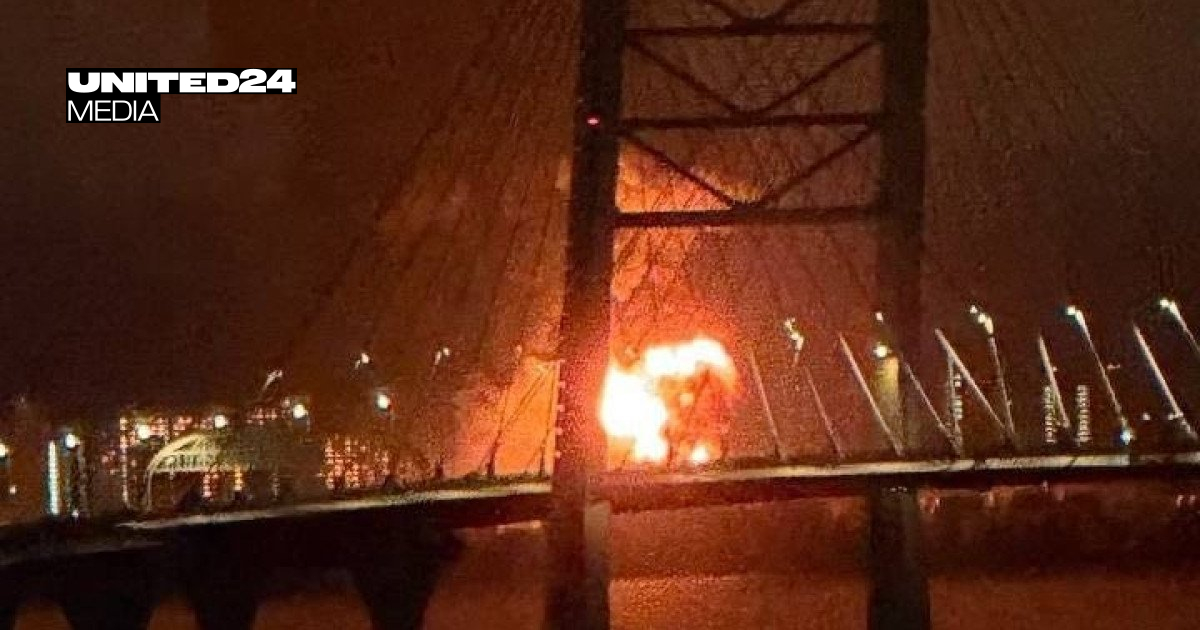
A massive wave of long-range Ukrainian drones breached Russian air defenses to strike Vladimir Putin's hometown of St. Petersburg on October 18, 2026. The widespread assault targeted critical infrastructure across Russia's second-largest city and the surrounding Leningrad region, setting an oil port ablaze and striking a major highway bridge.
Infrastructure Targeted Across St. Petersburg and Leningrad Region
According to OSINT investigations by ASTRA and Exilenova+, one of the primary targets of the overnight assault was the Korabelny Bridge. The eight-lane, cable-stayed bridge spans the Korabelny Fairway and forms a vital section of the Western High-Speed Diameter toll highway, connecting Bely Island in the Kirovsky district to Vasilyevsky Island. Eyewitness footage captured an explosion on the bridge, which has been geolocated to coordinates 59.919637° N, 30.209319° E. The precise extent of the structural damage has not yet been established.
The bridge connects Bely Island in St. Petersburg’s Kirovsky district with Vasilyevsky Island, forming part of the southern section of the Western High-Speed Diameter, a toll highway providing a major transport connection across the city. Measuring 622 meters in length and 39 meters in width, the bridge carries eight lanes of traffic. Construction began in 2013, and the crossing officially opened in December 2016.
The bridge strike occurred approximately 4.5 kilometers from the St. Petersburg Oil Terminal, where a fire broke out following the same overnight drone attack. The facility, which is capable of handling 12.5 million tons per year, caught fire during the attack. Beyond the oil terminal and bridge, the barrage impacted a VKontakte data center and the nearby Vostochnaya electrical substation in the Leningrad region, coinciding with power outages and disruptions to the Russian social media platform.
| Detail | Information |
|---|---|
| Date of Attack | October 18, 2026 |
| Bridge Dimensions | 622 meters long, 39 meters wide (eight lanes) |
| Bridge Opening Date | December 2016 (construction began 2013) |
| Oil Terminal Capacity | 12.5 million tons per year |
| Pulkovo Airport Disruptions | 327 flights delayed or cancelled |
| Moscow Flight Disruptions | 174 flights disrupted overnight |
Aviation Chaos and Regional Fallout
The aerial assault forced sweeping disruptions to civilian aviation across European Russia. Staff and employees at St. Petersburg's Pulkovo Airport were instructed to seek refuge in shelters as temporary suspensions took hold, with 327 flights delayed or cancelled. An additional 174 flights were disrupted overnight in Moscow, which has endured over a week of airport chaos due to Ukrainian drones. Neighboring Finland was similarly compelled to enforce flight restrictions in the eastern part of the Gulf of Finland as the long-range drones pounded St. Petersburg.
Russian reports stated that more than 200 "enemy drones" were shot down attacking Moscow and St. Petersburg. Air defences managed to down some drones, with debris sparking fires in apartment blocks. Local residents expressed terror as loud explosions echoed through the Nevsky district, with one stating: "Why does Putin persist with this pointless war. We're under siege. It's like in the history books from the Great Patriot War [WW2].
Political Repercussions and International Pressures
The attack represents a blow to Putin, who asserted that one objective of the war was to ensure Russia's safety. Immediate Russian demands for a devastating Putin retaliation to the St Petersburg assault included deploying his Oreshnik hypersonic nuclear-capable "mega-missile". Trump has called for an end of Ukrainian attacks on Russian oil facilities.
However, Ukrainian President Volodymyr Zelenskyy stated: "Russia is trying to create a blackout in Ukraine just before winter. Russia is trying to leave millions of our people without electricity and heating. Pressure is needed to stop this. American sanctions, a weakening of pressure on the aggressor, and financial rewards for Putin only encourage him to continue the attacks."
Simultaneously, Russian foreign policy maneuvers continued as Foreign Minister Sergey Lavrov addressed a ministerial meeting of the Russia-GCC strategic dialogue in Manama, Bahrain, stating that Russia supports the peacekeeping efforts of the Gulf Cooperation Council aimed at preventing a full-scale war in the Middle East. Meanwhile, French President Emmanuel Macron prepared to deliver a televised address in connection with October 17 unrest, during which mass demonstrations against rising fuel prices and declining purchasing power took place in Paris and throughout France.
Frequently Asked Questions
What specific infrastructure was hit in St. Petersburg?
The overnight drone attack struck the Korabelny Bridge, the St. Petersburg Oil Terminal, a VKontakte data center, and the Vostochnaya electrical substation in the Leningrad region.
How did the attacks affect civilian aviation?
Operations were temporarily suspended at Pulkovo Airport, where 327 flights were delayed or cancelled, while an additional 174 flights were disrupted overnight in Moscow.
As Russian authorities weigh immediate retaliatory demands—including deploying hypersonic nuclear-capable weaponry—the unfolding security situation continues to impact regional stability and diplomatic tensions.
How significant is this development?
Cast your anonymous vote to register reader sentiment across business and policy circles.
CurrentDeck is dedicated to independent, evidence-backed reporting. This briefing was synthesized from primary source reporting, corroborated across independent newsrooms, and verified against our Editorial Standards.