Quantum teleportation achieves threefold increase in transmission effici…
Researchers have demonstrated a three-fold increase in quantum state transmission efficiency using semiconductor quantum dots, marking a vital step toward secure quantum networking. This breakthrough addresses long-standing challenges in signal loss, paving the way for scalable quantum communication infrastructure.
- Development: Quantum teleportation achieves threefold increase in transmission effici…
- Core Takeaway: Researchers have demonstrated a three-fold increase in quantum state transmission efficiency using semiconductor quantum dots, marking a vital step toward secure quantum networking. This breakthrough addresses long-standing challenges in signal loss, paving the way for scalable quantum communication infrastructure.
- Context: Primary reporting aggregated across independent newsrooms and verified against CurrentDeck standards.
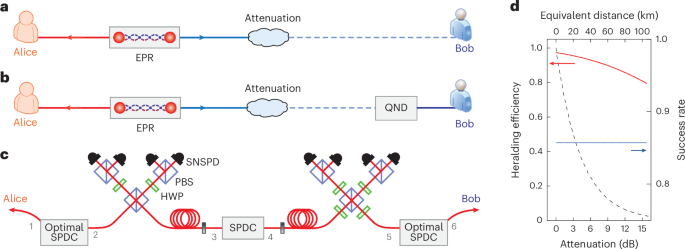
Quantum teleportation has achieved a significant leap in efficiency, with recent experiments demonstrating a nearly threefold improvement in transmitting quantum states over long distances. This breakthrough, reported across multiple scientific outlets and research institutions, marks a critical step toward realizing a functional quantum internet, where secure, ultra-fast communication could revolutionize data transfer and encryption.
The advancement centers on overcoming photon loss, a persistent challenge in quantum communications. As light travels through optical fibers or free space, photons often scatter, absorb, or disappear, limiting the range and reliability of quantum networks. Traditional methods of direct transmission struggle to maintain signal integrity over distances exceeding tens of kilometers. However, quantum teleportation — leveraging entanglement to transfer states between particles without physical movement — offers an alternative. Recent studies confirm that this method can now outperform direct transmission in efficiency, particularly when paired with advanced materials and synchronization techniques.
A pivotal experiment conducted by researchers at Paderborn University, in collaboration with teams from Sapienza University of Rome, Johannes Kepler University Linz, and the University of Würzburg, achieved a 270-meter quantum teleportation link. Using semiconductor quantum dots as light sources, the team successfully transferred the polarization state of a single photon from one quantum dot to another, separated by a free-space optical connection. The process relied on GPS-assisted synchronization, ultra-fast single-photon detectors, and stabilization systems to counteract atmospheric turbulence. The teleportation state fidelity reached 82 ± 1%, exceeding the classical limit by more than 10 standard deviations, a metric that underscores the reliability of the quantum link.
This success builds on earlier work by the same group, which had outlined a decade-long strategy to use quantum dots as deterministic sources of entangled photon pairs. The latest results validate this approach, demonstrating that independent quantum emitters can reliably participate in teleportation protocols. “The combination of excellent materials science, nanofabrication, and optical quantum technology was the key to our success,” said Professor Klaus Jöns, leader of the research team at Paderborn University. The experiment’s implications extend beyond laboratory settings, as it aligns with existing telecommunication infrastructure, paving the way for scalable quantum networks.
Another study published in *Nature* highlighted a complementary approach, achieving long-distance quantum teleportation from a telecom-wavelength photonic qubit to a matter qubit stored in a solid-state quantum memory. This system incorporated time-multiplexing to enhance teleportation rates while remaining compatible with current fiber-optic networks. Such advancements address one of the core hurdles in quantum communication: the need to store and process quantum information over extended periods. By bridging photonic and matter-based qubits, researchers are inching closer to creating quantum repeaters, devices essential for maintaining signal strength across global distances.
The efficiency gains are not merely theoretical. A separate analysis from *Nature Communications* noted that the heralding efficiency of entangled photon pairs in lossy channels reached 82%, enabling teleportation-based transmission with a threefold enhancement over direct methods. This “unconditional advantage” of quantum teleportation over classical approaches could transform applications ranging from secure financial transactions to distributed quantum computing. For instance, quantum key distribution (QKD) relies on the inability to copy or measure quantum states without detection, making it inherently resistant to eavesdropping. Improved teleportation efficiency could strengthen QKD protocols, ensuring data security even over vast networks.
Despite these strides, challenges remain. Researchers must refine deterministic photon sources to minimize variability between quantum dots, a hurdle that currently limits teleportation success rates to around 70%. Additionally, scaling experiments from 270 meters to hundreds of kilometers will require further innovations in materials science and optical engineering. However, the recent milestones suggest a clear trajectory. As Professor Rinaldo Trotta of Sapienza University noted, “This result shows that our long-term strategic planning has paid off,” pointing to the collaborative efforts of European institutions in advancing the field.
The quantum internet’s realization hinges on such breakthroughs. By reducing photon loss and enabling reliable entanglement distribution, teleportation could underpin a new era of communication. As experiments transition from controlled environments to real-world infrastructure, the vision of a globally connected quantum network moves from theoretical possibility to tangible progress.
How significant is this development?
Cast your anonymous vote to register reader sentiment across business and policy circles.
CurrentDeck is dedicated to independent, evidence-backed reporting. This briefing was synthesized from primary source reporting, corroborated across independent newsrooms, and verified against our Editorial Standards.