Gus the T. rex fossil heads to auction with expected $30 million price tag
A rare, 67-million-year-old T. rex skeleton named Gus will hit the auction block in 2026, igniting concerns about the commercialization of paleontology.
- Development: Gus the T. rex fossil heads to auction with expected $30 million price tag
- Core Takeaway: A rare, 67-million-year-old T. rex skeleton named Gus will hit the auction block in 2026, igniting concerns about the commercialization of paleontology.
- Context: Primary reporting aggregated across independent newsrooms and verified against CurrentDeck standards.
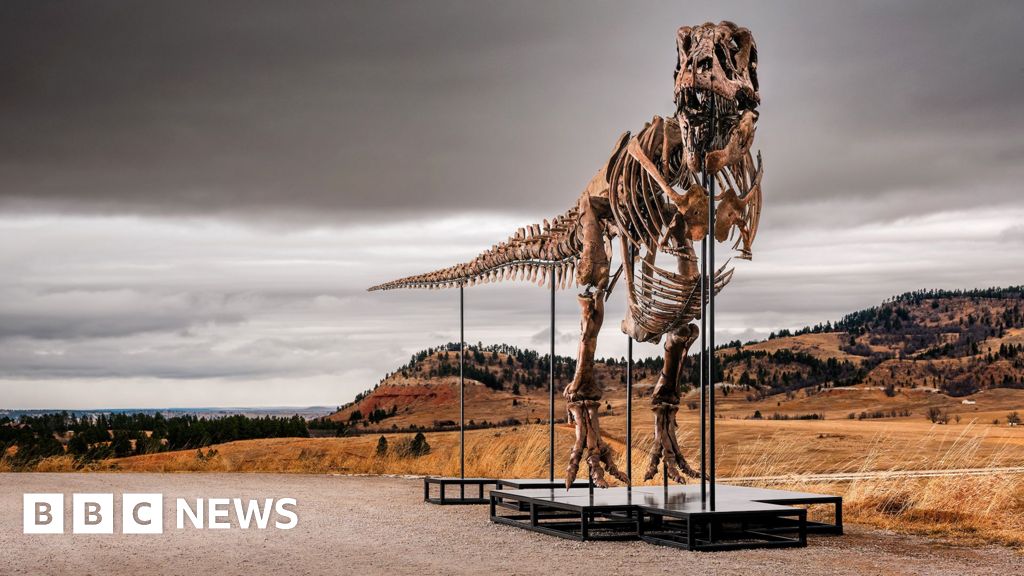
The 67-million-year-old T. Rex fossil known as Gus is set to become the most expensive dinosaur ever sold at auction, with an estimated price tag of $30 million. The skeleton, discovered on a South Dakota ranch and named after the late cattle rancher Gary “Gus” Licking, will be auctioned by Sotheby’s in New York on July 14, 2026. The specimen, described as one of the largest and most complete T. Rex fossils ever found, has sparked a heated debate over the ethics of fossil sales and their impact on scientific research.
Gus, measuring 38 feet long and standing 12.5 feet tall, contains 183 fossilized bones, representing 63% of the skeleton. Its skull, 4 feet long, is remarkably well-preserved, with 82% of its bones intact. The fossil includes evidence of a violent life, such as healed fractures on ribs and gastralia, as well as bite marks on the skull and body. These features, according to Sotheby’s, offer critical insights into the T. Rex’s behavior and survival strategies. The specimen was unearthed in 2021 on a 6,500-acre ranch owned by Licking, who had long suspected the presence of dinosaur remains beneath the soil. After his death during the excavation, the team named the fossil “Gus” in his honor.
The auction has drawn attention not only for its astronomical price but also for the broader implications for paleontology. Cassandra Hatton, global head of natural history at Sotheby’s, emphasized that the valuation reflects the immense effort and risk involved in recovering such a specimen. “For a lot of excavators, some of these people are living hand to mouth. They’re not wealthy people. They have to invest their own money,” she said. However, the high cost has raised concerns among scientists, who argue that private sales limit access to critical research materials.
Prof. Susannah Maidment, a dinosaur researcher at London’s Natural History Museum, highlighted the growing challenge of museums competing with wealthy collectors. “We’re already priced out of having access to many, many specimens,” she noted. Dr. Fiann Smithwick, an independent paleontologist, noted that many fossils recovered by private teams never reach museums, instead being sold to collectors or displayed in private galleries. “There are countless other specimens that will be scientifically more important in the grand scheme of palaeontology,” Smithwick said.
The tension between private and public ownership is not new. In 1997, the T. Rex “Sue” was sold to the Field Museum for $8 million, marking a shift in how fossils were valued. Since then, the market has exploded, with specimens like the 2024 sale of the Stegosaurus “Apex” for $44.6 million — the current record for a dinosaur auction. While auction houses argue that private buyers fund the recovery of fossils, critics warn that this practice prioritizes marketability over scientific integrity. Sotheby’s has attempted to mitigate concerns by reaching out to museums for participation in the auction. Hatton stated that the goal is to ensure “something that’s scientifically important to get it into the public trust.” However, the challenge remains: scientific journals often reject studies based on privately held fossils, effectively excluding them from academic discourse. Prof. Maidment pointed to historical examples, such as the loss of Mary Anning’s 1829 Squaloraja fossil during World War II, to underscore the fragility of private collections.
Despite these concerns, the auction underscores the cultural and economic allure of dinosaurs. Gus’s sale has already drawn interest from collectors and institutions alike, with a starting bid of $19 million. For some, the fossil represents a rare opportunity to own a piece of prehistory. For others, it symbolizes the growing divide between scientific preservation and commercial exploitation. As the debate continues, the fate of Gus — and the future of fossil research, hangs in the balance.
How significant is this development?
Cast your anonymous vote to register reader sentiment across business and policy circles.
CurrentDeck is dedicated to independent, evidence-backed reporting. This briefing was synthesized from primary source reporting, corroborated across independent newsrooms, and verified against our Editorial Standards.


