Archaeologists decipher name of ancient Maya astronomer Sak Tahn Waax
Researchers have deciphered the name of an 8th-century Maya mathematician, Sak Tahn Waax, from celestial formulas found in a Xultun ruins chamber. This discovery marks the first time an individual scholar has been identified in pre-Columbian scientific history.
- Development: Archaeologists decipher name of ancient Maya astronomer Sak Tahn Waax
- Core Takeaway: Researchers have deciphered the name of an 8th-century Maya mathematician, Sak Tahn Waax, from celestial formulas found in a Xultun ruins chamber. This discovery marks the first time an individual scholar has been identified in pre-Columbian scientific history.
- Context: Primary reporting aggregated across independent newsrooms and verified against CurrentDeck standards.
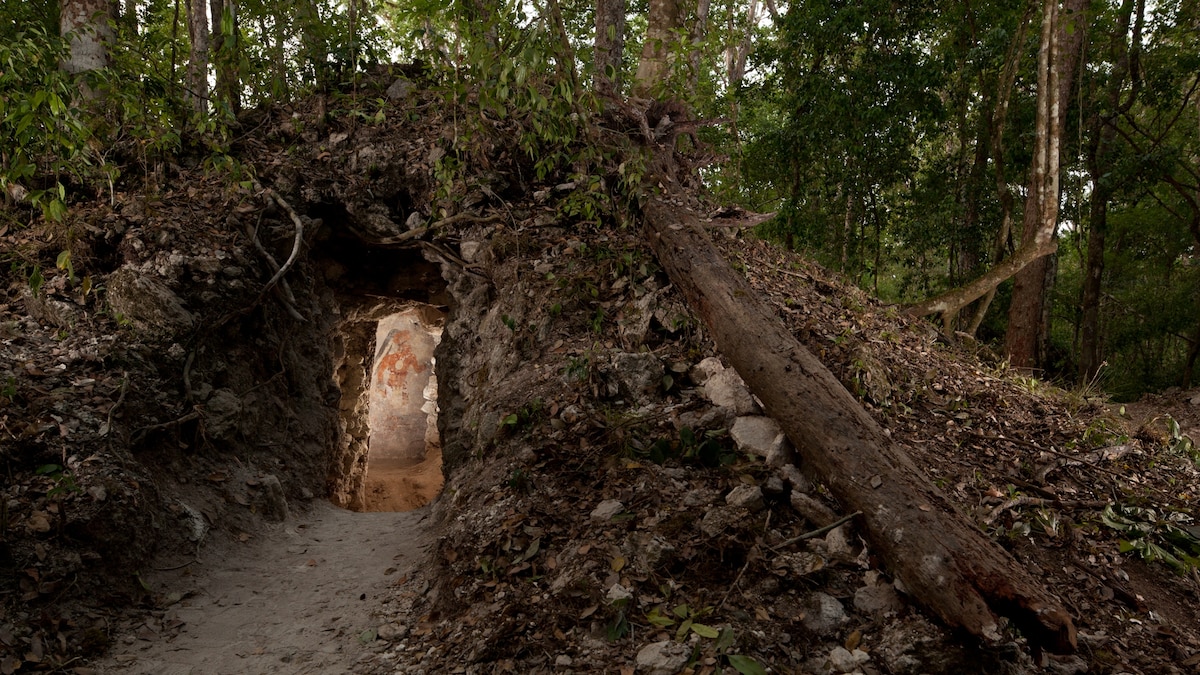
Archaeologists have uncovered the name of a revered Maya astronomer-mathematician for the first time, shedding light on the intellectual legacy of the ancient civilization. The individual, identified as Sak Tahn Waax — translating to “White-chested Fox” — was credited with a unique mathematical formula inscribed on the wall of a chamber at Xultun, an ancient Maya city in Guatemala. The discovery, published in the journal *Antiquity*, marks a pivotal moment in understanding the scientific traditions of the Maya, who developed sophisticated systems of astronomy and calendrical calculations without modern tools.
The name emerged from a set of 11 hieroglyphs found in Structure 10K-2, a small room within Xultun’s ruins. The inscriptions, part of over 50 mathematical and astronomical “microtexts” painted on the chamber’s walls, reveal a formula that links cycles of Venus and Mars to the Maya calendar. Researchers determined the text was attributed to Sak Tahn Waax, likely an expert in celestial observations who worked during the 8th century. The discovery provides the first direct evidence of a named Maya scholar whose contributions to science were formally acknowledged, contrasting with the anonymity of most ancient scribes.
David Stuart, an archaeologist and epigrapher at the University of Texas at Austin, described the find as akin to examining an “old whiteboard” in a scholar’s abandoned office. “To have a name associated with it is incredible,” he said. The formula, which calculates a 2,920-day cycle combining five Venus orbits and eight solar years, demonstrates the Maya’s advanced grasp of astronomical patterns. Heather Hurst, an archaeologist at Skidmore College, noted the text’s “playful” approach to mathematics, suggesting it was crafted by someone who viewed celestial calculations as both practical and intellectual pursuit.
Xultun, located 25 miles northeast of the famed city of Tikal, has been a focal point for research since 2008. The chamber containing the inscriptions was deliberately sealed with mud and rock, preserving its contents for centuries. Its walls, once faded, were reconstructed using multispectral imaging and digital enhancement. The space appears to have functioned as a workshop for scribes, where calculations for codices, Maya books on bark paper, were drafted. The discovery of papermaking tools nearby supports this theory, indicating the site was a hub for intellectual activity.
The name Sak Tahn Waax challenges previous assumptions about Maya scholarship. While rulers and political figures were often named in inscriptions, scientists and mathematicians remained unidentified. Franco Rossi, an archaeologist at MIT and lead author of the study, called the find “the first direct mention of an ancestral Maya astronomer-mathematician by personal name.” This revelation underscores the Maya’s recognition of intellectual contributions, akin to the acknowledgment of artists and sculptors in their society.
The formula’s complexity reflects the Maya’s integration of astronomy into daily life. Calculations like those attributed to Sak Tahn Waax guided decisions on royal ceremonies, construction projects, and religious events. The text also reveals a novel method for tracking planetary movements, combining the 260-day ritual calendar, the 365-day solar year, and cycles of Venus and Mars. “It’s just super nerdy math,” Hurst said, highlighting the ingenuity of the work.
Researchers emphasize that the discovery fills a critical gap in the historical record. While the Maya’s achievements in astronomy were long acknowledged, the absence of named scholars limited understanding of their intellectual networks. The attribution of the formula to Sak Tahn Waax suggests a tradition of scholarly recognition, possibly extending to other scribes whose work remains to be uncovered. “This is the first named scientist from the pre-Columbian Americas,” said Stuart, who noted the Maya’s independent development of scientific traditions separate from those of the “Old World.”
The findings also challenge narratives that downplayed Indigenous scientific knowledge. By linking the Maya to contemporaneous advancements in India, China, and the Mediterranean, the study positions Sak Tahn Waax alongside figures like Pythagoras and Galileo. “The Maya were very keen observers of nature, and they were always looking at patterns and connections,” Stuart said. “This is the first named scientist from the pre-Columbian Americas. I think it’s incredibly important that the Maya be seen as a culture immersed in scientific inquiry.”
As analysis of the chamber’s other microtexts continues, researchers hope to uncover more about the intellectual community of Xultun. The discovery of Sak Tahn Waax’s name not only honors an individual but also redefines how the world perceives the Maya’s scientific legacy, a legacy that, for the first time, bears a name.
How significant is this development?
Cast your anonymous vote to register reader sentiment across business and policy circles.
CurrentDeck is dedicated to independent, evidence-backed reporting. This briefing was synthesized from primary source reporting, corroborated across independent newsrooms, and verified against our Editorial Standards.


