Physicists explain quantum mechanics and the mechanics of entanglement
Discover how quantum entanglement has evolved from a theoretical challenge in the EPR paradox to a foundational pillar of modern quantum technology and computing.
- Development: Physicists explain quantum mechanics and the mechanics of entanglement
- Core Takeaway: Discover how quantum entanglement has evolved from a theoretical challenge in the EPR paradox to a foundational pillar of modern quantum technology and computing.
- Context: Primary reporting aggregated across independent newsrooms and verified against CurrentDeck standards.
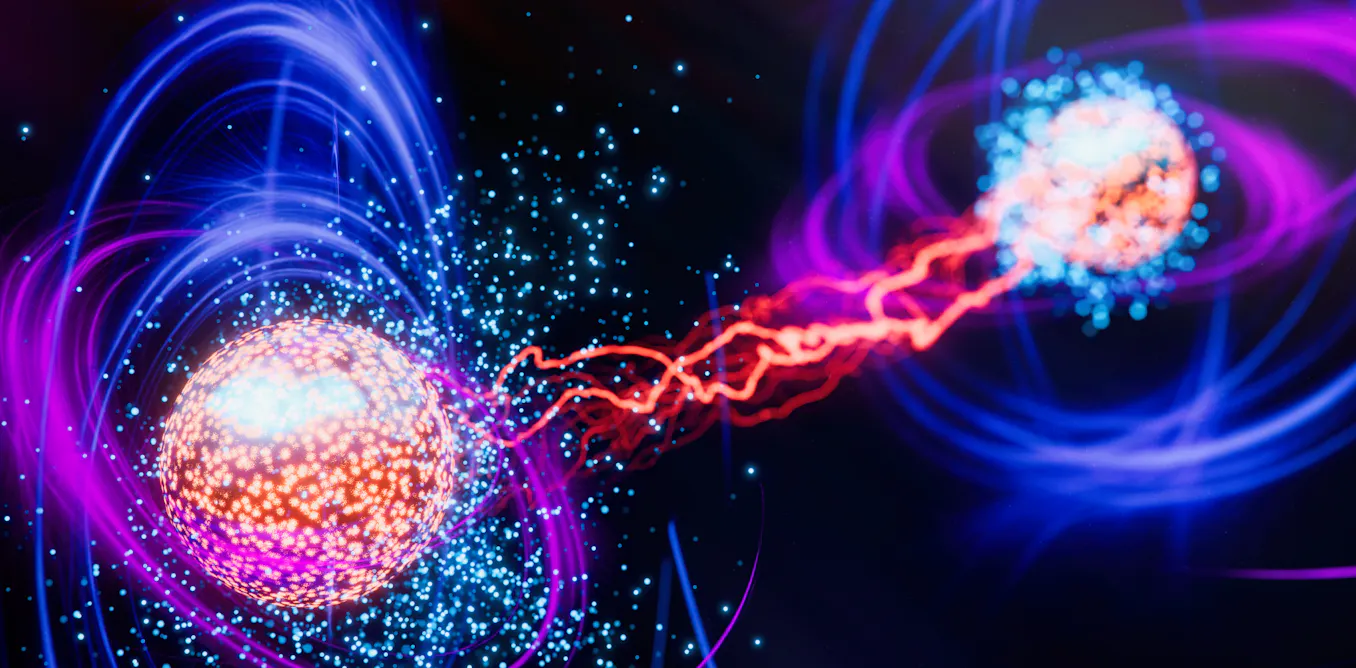
Quantum mechanics, a framework that describes the behavior of particles at the smallest scales, has long puzzled scientists and the public alike. At its core lies the concept of entanglement, a phenomenon so counterintuitive that even Albert Einstein dubbed it “spooky action at a distance.” Recent advancements and experimental validations have deepened our understanding of this enigma, revealing its foundational role in both theoretical physics and emerging technologies.
The 2022 Nobel Prize in Physics and the Validation of Entanglement
The 2022 Nobel Prize in Physics was awarded to Alain Aspect, John Clauser, and Anton Zeilinger for their pioneering work in confirming the reality of quantum entanglement. Their experiments, building on John Bell’s 1964 theoretical framework, demonstrated that entangled particles exhibit correlations that defy classical explanations. Bell’s inequality, a mathematical test, showed that no local hidden variables could account for the observed outcomes, effectively ruling out Einstein’s skepticism. This work solidified entanglement as a cornerstone of quantum mechanics, even as it challenged our intuitive understanding of space and time.
Quantum Superposition and the Nature of Reality
Entanglement arises from quantum superposition, the principle that particles exist in multiple states simultaneously until measured. For example, an electron’s spin can be both “up” and “down” until observed, collapsing into a definite state. This is not a limitation of measurement tools but a fundamental property of quantum systems. When two particles become entangled, their states are linked, such that measuring one instantly determines the state of the other, no matter the distance between them. This instantaneous connection, though seemingly violating the speed-of-light limit, does not enable faster-than-light communication, as no usable information is transmitted.
Einstein’s Skepticism and the EPR Paradox
Einstein, along with Boris Podolsky and Nathan Rosen, challenged entanglement in their 1935 “EPR paradox,” arguing that quantum mechanics must be incomplete. They proposed that particles might carry hidden variables dictating their behavior. However, Bell’s experiments and subsequent tests by Aspect and others disproved this, showing that entangled particles cannot be described by local hidden variables. Despite this, the exact mechanism behind entanglement remains a topic of debate, with some physicists questioning whether quantum mechanics offers a complete description of reality.
From Theory to Technology: Quantum Computing and Cryptography
Entanglement is not merely a theoretical curiosity; it underpins revolutionary technologies. Quantum computers, which leverage superposition and entanglement, promise to solve problems intractable for classical machines. A qubit, the quantum equivalent of a bit, can represent multiple states at once, exponentially increasing computational power. For instance, 300 qubits could theoretically encode more states than there are atoms in the universe. However, qubits are fragile, requiring extreme conditions like near-absolute-zero temperatures to maintain their coherence.
Quantum mechanics also threatens and enhances cybersecurity. Algorithms like RSA, which secure online data, could be cracked by sufficiently powerful quantum computers. In response, quantum key distribution (QKD) offers unbreakable encryption by detecting eavesdropping attempts. China’s 2017 satellite experiment demonstrated QKD over long distances, signaling a shift toward quantum-safe communication networks.
Challenges and Ethical Considerations
Despite progress, quantum technologies face hurdles. Current quantum computers lack the stability and scale to outperform classical systems for most tasks. Decoherence—interference from the environment—remains a critical obstacle. Moreover, the ethical implications of quantum advancements are profound. While quantum tools could revolutionize medicine and materials science, they also risk enabling unprecedented surveillance. As nations and corporations race to develop quantum capabilities, questions about equitable access and global governance loom large.
The Future of Quantum Exploration
Physicists continue to probe entanglement’s mysteries, with institutions like NASA exploring its applications in space. Experiments aim to study quantum phenomena in microgravity, while quantum sensors promise to enhance precision in fields from geology to astronomy. As research progresses, entanglement may redefine not only technology but also our understanding of the universe’s fundamental fabric.
Quantum mechanics, with its entanglement and superposition, challenges the boundaries of human knowledge. What began as a philosophical debate has evolved into a scientific and technological revolution, reshaping how we perceive reality and interact with the world. As the field matures, its implications will extend far beyond laboratories, influencing everything from global security to the next generation of computing.
How significant is this development?
Cast your anonymous vote to register reader sentiment across business and policy circles.
CurrentDeck is dedicated to independent, evidence-backed reporting. This briefing was synthesized from primary source reporting, corroborated across independent newsrooms, and verified against our Editorial Standards.