Researchers capture first-ever footage of Winteria telescopa barreleye fish
A deep-sea expedition in the Atlantic has recorded the first-ever natural habitat footage of the elusive Winteria telescopa barreleye fish. The discovery offers new insights into the extreme biological adaptations found within the ocean's depths.
- Development: Researchers capture first-ever footage of Winteria telescopa barreleye fish
- Core Takeaway: A deep-sea expedition in the Atlantic has recorded the first-ever natural habitat footage of the elusive Winteria telescopa barreleye fish. The discovery offers new insights into the extreme biological adaptations found within the ocean's depths.
- Context: Primary reporting aggregated across independent newsrooms and verified against CurrentDeck standards.
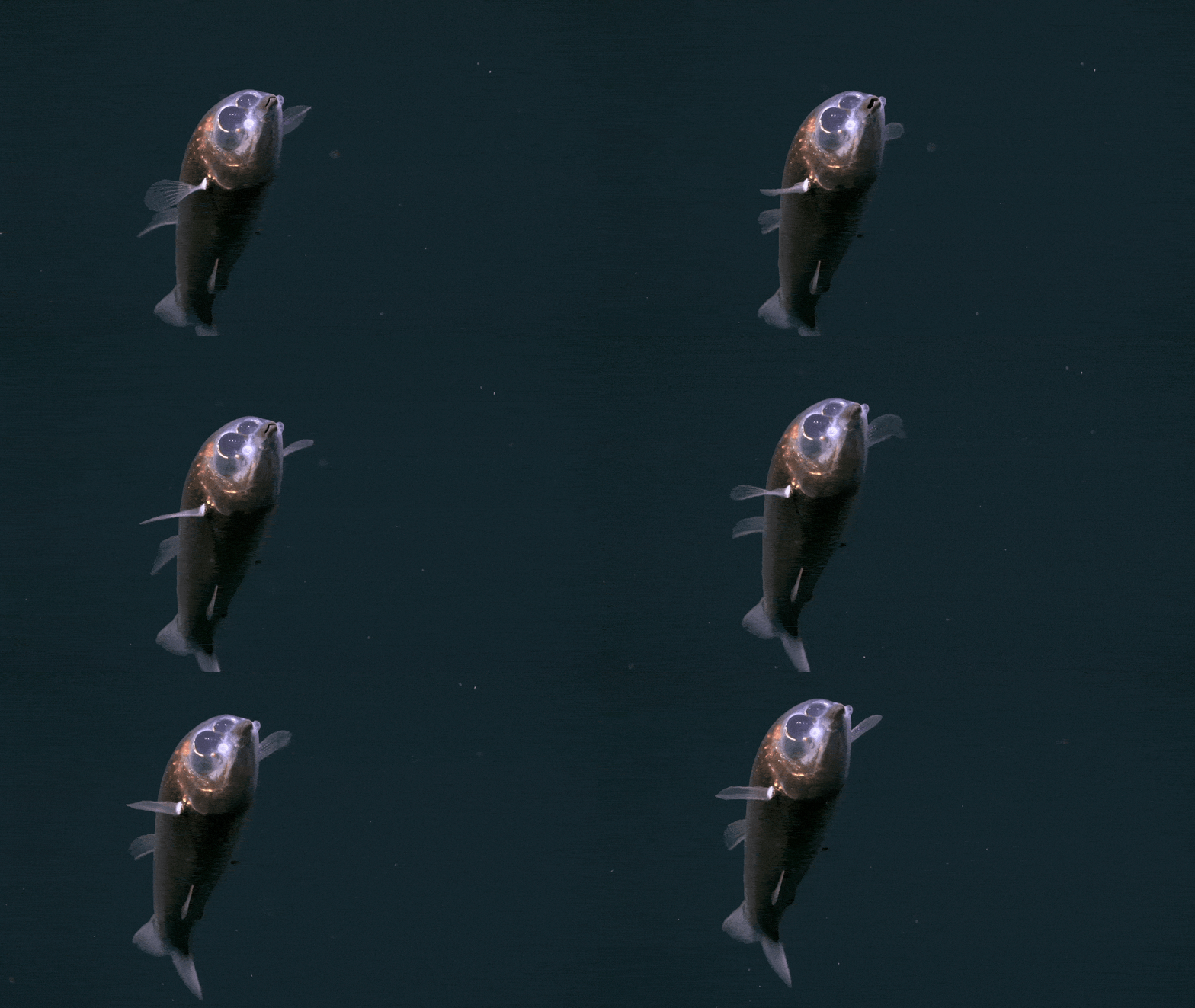
Researchers have captured the first-ever footage of the Winteria telescopa barreleye fish in its natural habitat, marking a significant milestone in deep-sea exploration. The discovery was made during an expedition to the Doldrums Megatransform and Fracture Zone, a remote region of the Atlantic Ocean where tectonic plates meet. The team, led by marine scientist Aaron Micallef of the Monterey Bay Aquarium Research Institute (MBARI), used the remotely operated vehicle SuBastian and the autonomous sub The Childlike Empress to explore the area, revealing previously unknown hydrothermal fields and rare deep-sea species.
The Doldrums, spanning 60,000 square kilometers (23,000 square miles) across the Mid-Atlantic Ridge, is a dynamic geological region where Earth’s crust is constantly reshaped. Over a month, the research vessel Falkor (too) served as the base for the team’s work, which included mapping the seafloor and studying its ecosystems. Among the most notable findings were two hydrothermal fields at a depth of nearly 4,000 meters (13,123 feet), where heat and chemicals seep from the Earth’s interior to create life-supporting oases. These vents, associated with serpentinization—a process that produces hydrogen and fuels microbial life—have drawn attention for their potential relevance to the search for extraterrestrial life on moons like Europa and Enceladus.
The expedition’s most captivating moment came when the team observed a Winteria telescopa barreleye fish at 710 meters. This species, previously unseen in its natural environment, is known for its translucent, fluid-filled head and tubular eyes that can rotate forward. The fish’s delicate dome collapses when removed from the water, making in-situ observations critical for understanding its adaptations. “This discovery shows why exploration still matters,” Micallef said. “Even in the Atlantic Ocean, where plate boundaries have been studied for decades, there are still places where the first close look can reveal something entirely new.”
At a much greater depth of 3,634 meters, the researchers encountered the bigfin squid, a species with tentacles reaching up to eight meters. The expedition also documented swarms of shrimp, ghostly crabs, and anemones thriving near hydrothermal chimneys. “We arrived searching for vents, faults, and seamounts,” said marine scientist Paula Zapata Ramirez of the Universidad Pontificia Bolivariana in Colombia. “We leave with something even more valuable: a deeper understanding of ecosystems in one of the least explored regions of the Atlantic Ocean.”
The footage of the barreleye fish, a species often mistaken for a science-fiction creature, highlights the extreme adaptations required for survival in the deep sea. Its transparent head functions as a protective shield for its upward-facing eyes, which can rotate to track prey. “The barreleye’s eyes are not fixed,” explained Jyotika Virmani, executive director of the Schmidt Ocean Institute. “They can rotate forward, allowing the fish to aim precisely at food while remaining hidden from predators.” This discovery shows how much remote exploration in revealing the hidden mechanisms of deep-sea life.
While scientific papers on the findings are pending, the expedition has already reshaped perceptions of the Atlantic’s uncharted depths. “Every sample, every image, and every discovery brings us one step closer to understanding the hidden parts of our planet,” said Zapata Ramirez. The team’s work not only expands knowledge of Earth’s geology and biology but also raises questions about the potential for life in extreme environments beyond our world.
How significant is this development?
Cast your anonymous vote to register reader sentiment across business and policy circles.
CurrentDeck is dedicated to independent, evidence-backed reporting. This briefing was synthesized from primary source reporting, corroborated across independent newsrooms, and verified against our Editorial Standards.


